
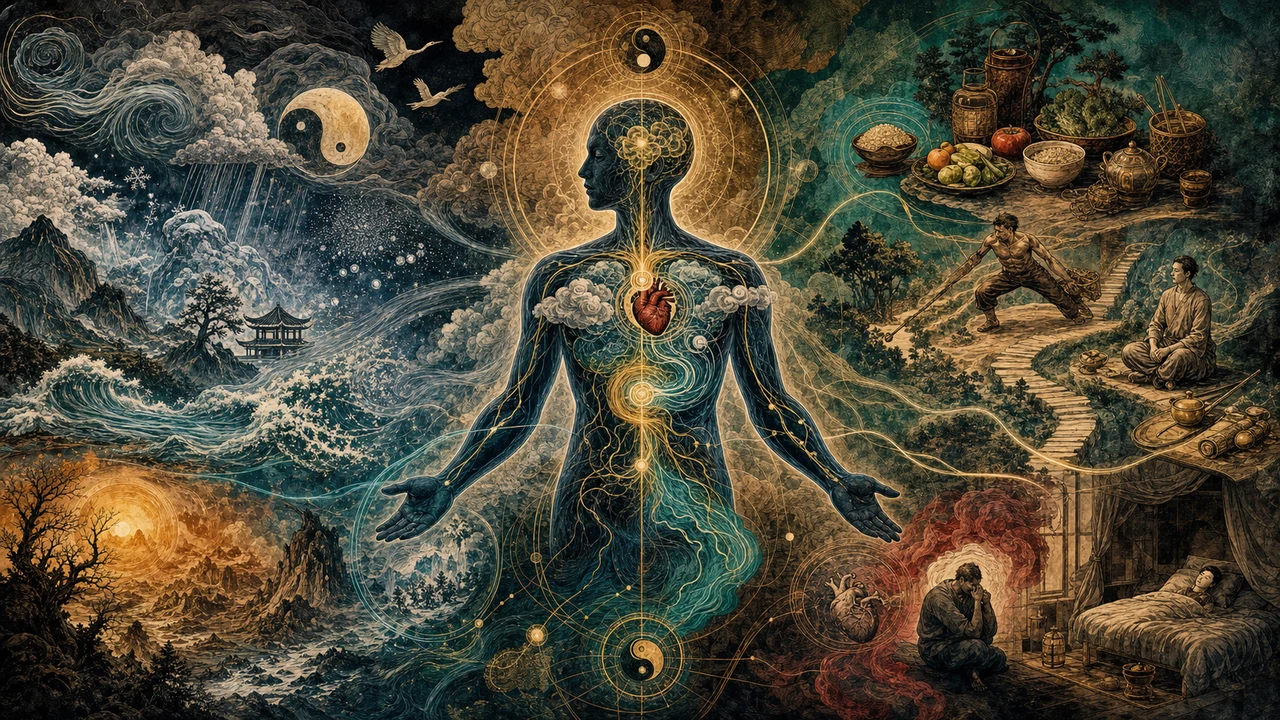
In Chinese Medicine, the causes of disease are organized into three broad categories: external, internal, and neither internal nor external. They encompass climatic influences, emotions and factors such as diet, exertion, trauma, habits and exposures.
In this article, you will understand how the theory of the Three Causes emerged, which factors belong to each group, how they become pathogenic and why different categories may participate in the same process of illness.
Continue reading to understand how this classification helps investigate the origin and development of imbalances within Chinese Medicine.
What are the three categories of causes of disease?
Traditional Chinese Medicine organizes the causes of disease into three broad groups: external causes, internal causes, and causes that are neither internal nor external. This classification is known as the theory of the Three Causes and seeks to identify where the factor that initiated or contributed to a particular disease process came from.
External causes are related primarily to environmental and climatic influences. Internal causes correspond to emotions when they become excessive or persistent. The third group encompasses inadequate diet, excessive exertion, physical inactivity, trauma, parasites, toxins and other factors that do not belong exclusively to the first two categories.
These categories do not represent diagnoses or specific diseases. They function as a framework for investigating the origin and development of a condition. The same manifestation may result from different factors, and a disease may simultaneously involve elements belonging to more than one causal category.
How did the theory of the Three Causes emerge?
The classification was systematized during the Song dynasty by the physician Chen Yan, also known as Chen Wuze. In 1174, he completed a work whose title may be translated as Formulas and Discussions That Bring Together Diseases, Their Signs, and the Three Categories of Causes.
Chen Yan did not invent all the causal factors described by Chinese Medicine. Climatic influences, emotions, diet and exertion had already appeared in earlier texts. His contribution was to organize this knowledge into a broad classification capable of gathering different origins of illness into three principal groups.
This organization became an important reference for the study of Chinese etiology. It makes it possible to distinguish what originates in the environment, what begins in emotional experience and what results from habits, accidents or other conditions. The division remains present in contemporary Traditional Chinese Medicine terminology.
What are the external causes of disease?
External causes are factors from the environment that may interfere with the body's functioning. Traditional theory recognizes six principal influences: Wind, Cold, Summer Heat, Dampness, Dryness and Fire. They are originally natural conditions related to climate and seasonal changes.
These influences are not considered harmful in every circumstance. The body normally adapts to heat, cold, dampness and other environmental variations. They become pathogenic factors when they appear in an excessive, sudden, prolonged way or one that is incompatible with the season.
Individual capacity for adaptation also affects this process. The same climatic condition may produce different effects according to a person's constitution, general state, exposure and previous condition. The presence of cold, heat or dampness in the environment therefore does not automatically determine the onset of disease.
How do external factors become pathogenic?
In traditional language, the six climatic influences are called the Six Qi while they remain part of nature's normal conditions. When they exceed the body's capacity for adaptation and participate in disease, they are called the Six Excesses or external pathogenic factors.
Each factor is recognized by its own characteristics. Wind is related to mobility and rapid changes; Cold to contraction; Dampness to heaviness and slowness; Dryness to loss of fluids; Summer Heat to seasonal intensity; and Fire to intense manifestations of heat.
External factors may also appear in combinations such as Wind-Cold, Wind-Heat or Wind-Dampness. After entering the body, they may change their characteristics or advance to deeper regions. These expressions describe traditional patterns and do not directly correspond to specific microorganisms or biomedical diagnoses.
What are the internal causes of disease?
Internal causes correspond to emotions when their intensity, duration or repetition interferes with a person's functioning. In Chinese Medicine, emotions are part of life and are not considered pathogenic by nature. A problem arises when they remain excessive or become difficult to process.
These experiences are called internal because they may directly change the movement of Qi and the functions attributed to the Zang-Fu systems. Unlike climatic factors, they do not need to penetrate the body's surface. Their influence begins in the individual's own mental and emotional experience.
The relationship may also occur in the opposite direction. A prolonged physical condition may change the emotional state, increasing irritability, fear, sadness or worry. Chinese Medicine understands this connection as reciprocal and avoids completely separating bodily functioning from psychic experience.
What are the seven emotions considered internal causes?
The Seven Emotions are joy, anger, worry, excessive thinking, sadness, fear, and fright or shock. Translations vary because some Chinese terms may be presented as anxiety, grief, reflection, apprehension or melancholy. Despite linguistic differences, the classification seeks to represent seven fundamental emotional movements.
Each emotion is traditionally related to a certain movement of Qi. Anger tends to make it rise, fear to send it downward, sadness to disperse it, excessive thinking to bind it and shock to disorganize it. These descriptions indicate functional tendencies, not mandatory reactions in every person.
The classification also does not assign moral value to emotions. Feeling anger, joy, sadness or fear does not mean being ill or voluntarily causing disease. Clinical meaning depends on intensity, persistence, context and the presence of other manifestations that form a coherent pattern.
What are causes that are neither internal nor external?
The third category has names such as causes that are neither internal nor external, neutral, miscellaneous or mixed causes. It encompasses factors that do not arise directly from the climate and are not produced primarily by emotions. It is a broad group related to the practical and material conditions of life.
Its components include irregular diet, excessive or insufficient food, overwork, insufficient rest, prolonged inactivity, inappropriate physical exertion, excessive sexual activity, trauma, accidents, parasites, toxins and treatments applied incorrectly.
These factors may act quickly, as in an accident, or produce consequences gradually, as happens with habits maintained for a long time. What brings them together is their origin: they result from behaviors, exposures, injuries or circumstances that belong neither exclusively to the climatic environment nor to emotional life.
How can diet, work and trauma participate in illness?
Diet may become a causal factor when its quantity, quality or regularity does not meet a person's needs. The theory considers both excess and insufficiency, as well as the recurring consumption of unsuitable, contaminated or spoiled food. These factors interfere mainly with the use of nutritional resources.
Work, exercise and rest need to maintain a relationship compatible with individual capacity. Excessive activity may consume resources and reduce recovery, while prolonged inactivity may impair bodily movement. The problem is not exertion or rest itself, but a lack of adaptation and balance.
Trauma acts more directly. Falls, cuts, burns, fractures, sprains and other injuries may interrupt normal circulation in the affected tissues. Parasites and toxins also belong to this category because they represent concrete agents capable of causing changes without being classified as emotions or climatic influences.
How can the three categories act at the same time?
The three causes do not need to occur in isolation. Environmental exposure may affect someone more intensely when they are exhausted, eating poorly or experiencing persistent emotional suffering. In this case, external, internal and miscellaneous factors contribute jointly to the development and continuation of the condition.
Constitution also affects the response. People exposed to the same environment or subjected to similar habits may react differently. In traditional theory, resistance depends on the body's resources, its previous condition and the intensity of the causal factors encountered.
Identifying the causal category is only one part of assessment. The practitioner still needs to observe the affected location, nature of the manifestations and mechanism produced. The Three Causes belong to the Chinese Medicine model and do not replace medical examinations or diagnoses in the presence of persistent, intense or potentially serious symptoms.
Frequently Asked Questions
They are external causes, internal causes and causes that are neither internal nor external.
Wind, Cold, Summer Heat, Dampness, Dryness and Fire.
Joy, anger, worry, excessive thinking, sadness, fear, and fright or shock.
They are factors such as an inadequate diet, excessive exertion, insufficient rest, physical inactivity, trauma, parasites and toxins.
Yes. Environmental and emotional factors and those connected with habits or living conditions may participate together in the same process.
Deepen your exploration of the causes of disease
Understanding external, internal and miscellaneous causes broadens the interpretation of disease processes within Chinese Medicine.
Explore our e-books for clear, structured material that connects energetic foundations with personal awareness and daily practice.
Explore the e-books
About the author
Prof. Tibério Z has more than 30 years of experience teaching spirituality, metaphysics, holistic therapies and consciousness development.