
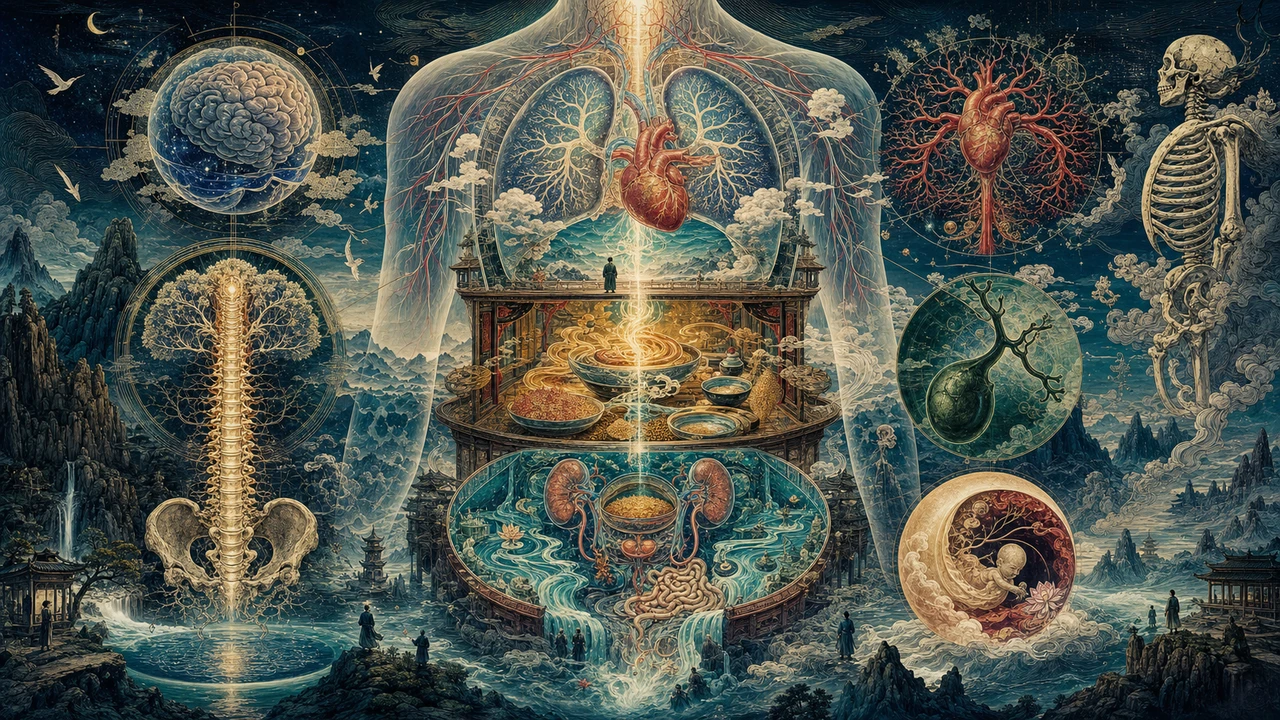
In Chinese Medicine, the Triple Burner is a functional structure that integrates the upper, middle, and lower regions of the body and provides passage for Qi and fluids. The Extraordinary Fu organs form a special category that brings together the Brain, Marrow, Bones, Vessels, Gallbladder, and Uterus because of their ability to preserve essential substances.
In this article, you will understand why the Triple Burner does not correspond to a single anatomical organ, how its three regions coordinate respiration, the transformation of food, and elimination, as well as the characteristics and functions attributed to the six Extraordinary Fu organs.
Continue reading to understand how these concepts expand the functional organization of the body and connect circulation, integration, development, reproduction, and storage within Chinese Medicine.
What the Triple Burner is in Chinese Medicine
The Triple Burner, called Sanjiao in Chinese, is one of the six Fu organs of Traditional Chinese Medicine. It does not perform only a localized function, but organizes communication among different regions of the body. The World Health Organization defines it as the structure formed by the upper, middle, and lower burners.
Its primary function is to provide passage for the circulation of Qi and fluids. It also participates in Qi transformation, allowing the activities attributed to the different internal systems to occur in a coordinated way. Therefore, the Triple Burner is understood as a functional structure of integration.
The name “Triple Burner” does not mean that there are three physical sources of heat inside the body. The word burner attempts to convey the idea of three areas in which movements, transformations, and distributions take place. Each region brings together certain systems and represents a different stage of bodily functioning.
Why the Triple Burner does not correspond to a single anatomical organ
Unlike the Stomach, Bladder, or Large Intestine, the Triple Burner does not correspond directly to an individual anatomical structure. It is used to describe a functional organization that encompasses the torso and connects the activities carried out in its upper, middle, and lower regions.
This characteristic explains why different translations are found, such as Triple Burner, Triple Energizer, Triple Heater, or simply Sanjiao. None fully reproduces the original term. International terminology keeps the Chinese name alongside the translation to prevent the concept from being confused with a specific physical organ.
The Triple Burner should be understood through the function it performs. It represents the spaces and pathways through which Qi and fluids circulate, as well as the coordination among respiration, the use of food, and elimination. Its meaning emerges from the relationship among these activities, not from the presence of a single anatomical form.
How the Triple Burner is divided
The Triple Burner is divided into the Upper Burner, Middle Burner, and Lower Burner. This division organizes the torso into three large functional regions. The diaphragm and navel are used as references to distinguish the areas, although they are not considered completely isolated compartments.
Each burner brings together systems that participate in activities that predominate in that region. The upper is related mainly to the Heart and Lung; the middle, to the Spleen and Stomach; and the lower, to the Kidneys, Bladder, and intestines. This classification makes it easier to understand movement among the different areas.
The three divisions need to remain connected. What is received and transformed in the Middle Burner provides resources that will be distributed by the Upper Burner. Fluids conducted downward continue to be separated and eliminated by the Lower Burner. Sanjiao represents precisely the continuity that exists among these stages.
What the functions of the Upper Burner are
The Upper Burner is located above the diaphragm and mainly includes the Heart and Lung. It is related to respiration, circulation, and the distribution of Qi and fluids toward the different regions of the body, especially the body's surface.
The Lung receives air and participates in the formation of Qi gathered in the chest. The Heart propels Blood through the vessels. Within the Upper Burner, these activities are observed as closely connected processes because respiration, circulation, and distribution need to remain coordinated to reach the other parts of the body.
This region also participates in the diffusion of lighter fluids. They are directed to the skin, muscles, and superficial areas, contributing to moisture and perspiration. The Upper Burner therefore represents the beginning of the distribution of resources produced or gathered internally.
What the functions of the Middle Burner are
The Middle Burner is located between the diaphragm and navel and mainly includes the Spleen and Stomach. Its activity is related to receiving, breaking down, transforming, and making use of ingested food and drink.
The Stomach receives and begins processing the ingested contents, while the Spleen participates in extracting and transporting the nourishing parts. The Middle Burner brings these activities together in the same functional region, showing how reception, transformation, and distribution form consecutive stages.
The usable components continue to other areas, where they participate in the formation and maintenance of the substances the body needs. Waste continues downward to new stages of separation. Thus, the Middle Burner functions as a region of passage between what enters the body and what will be used or eliminated.
What the functions of the Lower Burner are
The Lower Burner is located below the navel and includes the Kidneys, Bladder, Small Intestine, and Large Intestine. It is related primarily to the final separation of contents, transformation of fluids, temporary storage, and elimination of waste.
In this region, the Small Intestine continues separating usable components from waste, while the Large Intestine conducts solid material toward evacuation. The Kidneys and Bladder participate in transforming, storing, and excreting the fluids that will form urine.
The Lower Burner should not be reduced only to the urinary or intestinal system. It brings together different processes that share a downward direction and the purpose of separating, preserving, or eliminating. Its activity completes the path begun in the upper and middle regions.
How the Triple Burner coordinates Qi and fluids
The World Health Organization describes the Triple Burner as a passage for the circulation of Qi and water. This means that it enables communication among the three regions and favors the ascending, descending, entering, and exiting movements required by internal functions.
Sanjiao also participates in the distribution of Original Qi, associated with the constitutional foundation of the Kidneys. Through its pathways, this resource reaches the different systems and contributes to their activities. The Triple Burner does not produce this Qi on its own, but provides the conditions for its circulation and manifestation.
Fluids depend on the same pathways to be received, transformed, distributed, and eliminated. One part rises and reaches the superficial regions, while another descends to be separated and excreted. The Triple Burner coordinates these directions, integrating the different stages of the traditional metabolism of fluids.
What the Extraordinary Fu organs are
The Extraordinary Fu organs form a special category in Chinese Medicine. They are called Fu because they have hollow structures or cavities, but differ from ordinary Fu organs because they store essential substances. In this way, they bring together characteristics attributed both to the Zang organs and to the Fu viscera.
While ordinary Fu viscera receive, transform, and transport food or waste, the extraordinary organs do not function primarily as passageways for this content. They preserve materials such as Marrow, Blood, or bile and participate in constitution, development, reproduction, and the body's support.
The category includes six structures: Brain, Marrow, Bones, Vessels, Gallbladder, and Uterus. Except for the Gallbladder, they do not form the same internal-external pairs found in the ordinary Zang-Fu system. They are grouped together because of the special characteristics they share.
What the functions of the six Extraordinary Fu organs are
The Brain is called the Sea of Marrow, while Marrow represents the material that fills and nourishes the brain, spine, and bones within traditional theory. These two concepts are related to consciousness, memory, perception, coordination, and the development of internal structures.
The Bones store Marrow and provide support for the body. The Vessels contain and conduct Blood, which is why they are also included among the Extraordinary Fu organs. Although they have cavities, both preserve essential substances instead of directly transporting food or waste.
The Gallbladder stores bile, a substance considered pure, and therefore belongs simultaneously to the ordinary and Extraordinary Fu organs. The Uterus stores menstrual Blood and participates in menstruation, conception, and pregnancy. These functions explain their relationship with preservation, reproduction, and development.
Frequently Asked Questions
The Triple Burner, or Sanjiao, is a functional structure that integrates different regions of the body and provides passage for Qi and fluids.
No. It describes a functional organization that encompasses the torso and connects activities carried out in the upper, middle, and lower regions.
They are the Upper Burner, connected mainly to the Heart and Lung; the Middle Burner, connected to the Spleen and Stomach; and the Lower Burner, connected to the Kidneys, Bladder, and intestines.
They are structures that have cavities but differ from ordinary Fu organs because they store essential substances.
Brain, Marrow, Bones, Vessels, Gallbladder, and Uterus.
Deepen your study of the Triple Burner
Understanding Sanjiao and the Extraordinary Fu organs broadens our view of circulation, integration, storage, and development in Chinese Medicine.
Explore our e-books for clear, organized material that connects these and other traditional concepts with the practice of Chinese Medicine.
Explore the e-books
About the author
Prof. Tibério Z has more than 30 years of experience teaching spirituality, metaphysics, holistic therapies and consciousness development.