
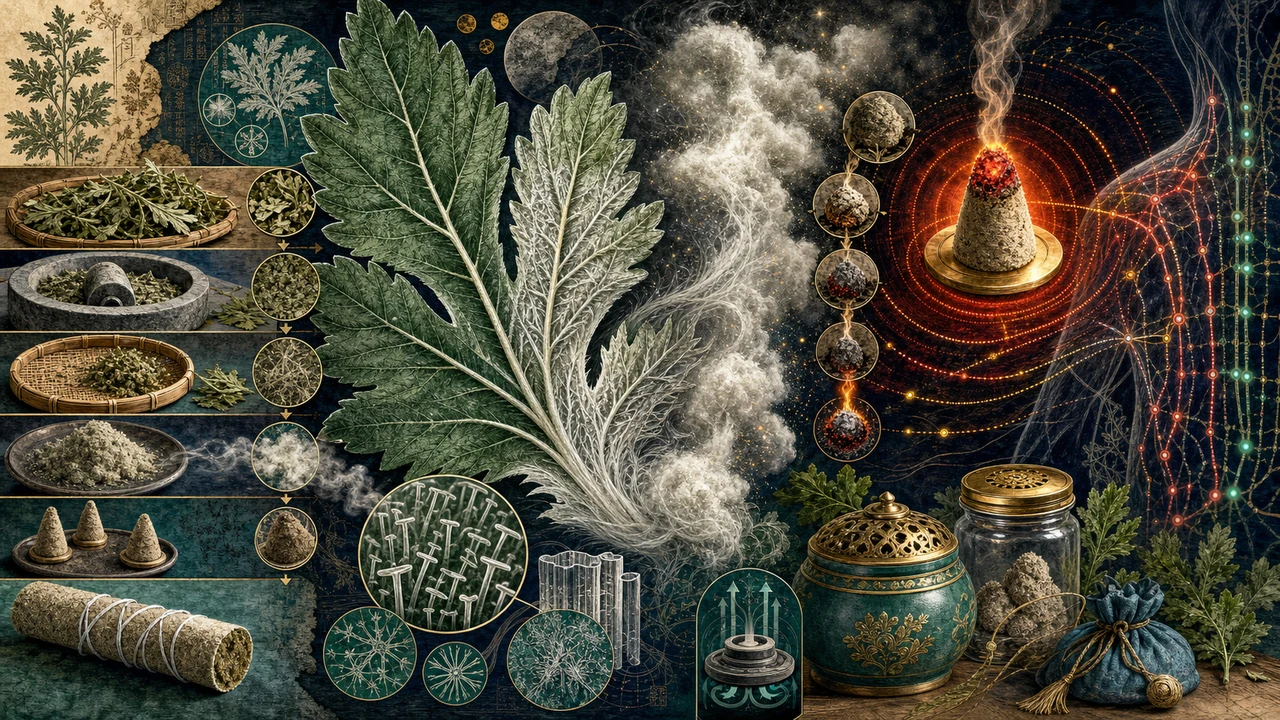
Moxa is the combustible material prepared from dried and processed mugwort leaves to produce heat during moxa therapy. The plant is used because its leaves produce a light, moldable fiber capable of maintaining controlled combustion in different forms of application.
In this article, you will understand which species of mugwort is most commonly used, how the leaves are transformed into moxa wool and which characteristics of the plant favor its combustion. You will also learn about grades of purity, aging, forms of presentation and the precautions needed to recognize suitable material.
Continue reading to follow the path from the mugwort leaf to finished moxa and understand why botanical origin, processing, storage and safety make a difference in practice.
What is moxa?
Moxa is the combustible material prepared for moxa therapy. In its traditional form, it is produced from dried and processed leaves of plants in the Artemisia genus. Processing transforms the leaves into a light, fibrous mass called moxa wool, fiber or floss.
The word moxa does not refer only to the freshly harvested plant. It mainly denotes the product obtained after the leaves have been dried, ground, sifted and separated from coarser parts. This fiber can be used loose or formed into cones, small grains, sticks and other shapes intended for combustion.
During application, moxa is lit to produce heat over points or regions of the body. Depending on the technique, it may be placed directly on the skin, positioned over a barrier or held at a certain distance. Moxa is therefore the material used, while moxa therapy is the therapeutic procedure performed with it.
Which species of mugwort is used in moxa?
In the Chinese tradition, the main species used is Artemisia argyi, a perennial plant in the Asteraceae family that is widely distributed across East Asia. Its leaves are traditionally called Aiye and are the most common raw material for producing the wool used in Chinese moxa therapy.
However, the word mugwort refers to a genus containing numerous species. Other East Asian traditions may use related plants. In Japan, for example, studies describe the use of Artemisia princeps, known as Japanese mugwort, in the preparation of moxa for different moxibustion methods.
It is therefore not correct to say that any mugwort produces moxa with the same characteristics. The species have morphological, chemical and thermal differences. Botanical identification, the cultivated variety, place of production and processing method can alter the yield and quality of the final material.
How are the leaves transformed into moxa wool?
Production begins with harvesting and drying the leaves. After they lose much of their moisture, they are ground or pounded repeatedly. This process breaks down plant tissues, releases fibers from the leaf surface and allows the soft material to be separated from veins, stems and coarser particles.
The ground material is sifted several times. Sifting removes heavy fragments and preserves a fine, light mass resembling cotton. The greater the degree of refinement, the fewer hard leaf parts tend to remain and the more uniform the wool used to prepare the moxa becomes.
The result is a fiber that can be compressed to different densities. Very loose moxa burns differently from moxa that is tightly packed. Grinding, sifting, purity, quantity and compression are therefore not merely manufacturing details: these factors modify combustion and the intensity of heat produced during application.
Which characteristics of mugwort favor the production of moxa?
The leaves of Artemisia argyi have numerous trichomes, small hair-like structures that cover their surface. Morphological studies show that non-glandular T-shaped trichomes are important structural components of moxa wool and occur in greater concentration on the underside of the leaves.
When the leaves are ground, these trichomes are released and join together, forming the characteristic fibrous mass. Their structure favors the production of a light, moldable material that can remain grouped. This makes it possible to prepare anything from small grains used on the skin to larger cones and compressed sticks.
The quantity and shape of the trichomes influence production yield. Plants with different leaf characteristics may generate different quantities of fiber after sifting. The variety, cultivation, harvest time and quality of the leaves therefore affect the proportion of moxa obtained and its final characteristics.
Why is mugwort combustion suitable for moxa therapy?
Once processed, mugwort produces a fibrous biomass that can be lit and kept burning. This characteristic makes it possible to generate heat for the time needed to stimulate a bodily region. The rate of combustion can be modified through the quantity, compaction and shape chosen for application.
The wool can also be shaped into very small units. This possibility is important because some techniques require brief, localized stimuli, while others use sticks held near the skin for longer periods. The same material can therefore produce different applications according to its volume and preparation.
Thermal research shows that moxa combustion occurs in different stages, involving moisture loss, decomposition of plant components and burning of the charred material. These processes determine the amount of heat, duration of combustion and products released, but they do not show that every type of moxa produces exactly the same stimulus.
What do purity and leaf ratio mean for moxa quality?
Moxa quality is often described by a ratio between the amount of dried leaves used and the amount of wool produced. A ratio of 10 to 1, for example, indicates that ten units of leaves were processed to obtain approximately one unit of refined fiber.
A higher ratio usually indicates that more coarse particles were removed during processing. However, this number alone does not measure the material's entire quality. Botanical identification, growing conditions, drying, storage, moisture, the presence of impurities and combustion characteristics must also be considered when assessing the product.
Different grades of purity may be intended for different techniques. Finer, more uniform fiber makes it easier to prepare small units for precise applications. Coarser materials may be used in sticks or indirect methods in which moxa remains away from the skin or is separated from it by a barrier.
Why do some traditions use aged moxa?
The Chinese tradition values using leaves or wool that have been stored for a certain period before combustion. This material is called aged moxa. The practice is based on the idea that resting and storage modify the moisture, odor, texture and behavior of the fiber while it burns.
Commercial moxa may be classified as recent or aged for one, three, five years or longer. However, the age printed on the package does not by itself prove that the material is of superior quality. Actual storage conditions, the origin of the leaves and processing also influence the product's characteristics.
Studies have compared materials from different species and storage periods, but the researchers themselves acknowledge that there is still insufficient data to confirm every traditional claim about the superiority of aged moxa. Storage time should therefore be treated as one possible criterion, not as an automatic guarantee of quality or efficacy.
What are the main forms of moxa?
Loose wool is the basic form of moxa. It can be separated into small portions, compressed between the fingers and shaped into grains or cones. These units vary in size according to the technique, from very small pieces used in direct applications to larger cones placed on supports or barriers.
In sticks, the fiber is compressed and wrapped in paper, forming a cylinder similar to a cigar. After it is lit, the stick is held near the skin and moved by the practitioner. There are also products for application on needles, warming boxes and devices that support the moxa during combustion.
Versions described as smokeless moxa are also sold, often made with carbonized material. They reduce some of the visible smoke but have a different composition and thermal behavior from traditional wool. This substitution therefore changes the type of combustion and should not be understood as merely a change in format.
Do the chemical compounds in mugwort participate in moxa therapy?
The leaves of Artemisia argyi contain volatile oils, flavonoids, phenolic acids and other plant components. Some of these substances remain in the processed raw material, while others may be modified, degraded or released during combustion. Composition also varies among varieties, regions and preparation methods.
Laboratory analyses have identified numerous substances in the plant material and the smoke produced by moxa. However, detecting a compound does not show that it reaches the body in a therapeutic amount or that it is responsible for a particular clinical result. The contribution of these components remains less clear than the direct presence of the thermal stimulus.
Combustion also releases inhalable particles and substances that can irritate sensitive people. Studies of prolonged exposure show the importance of ventilation, while clinical reports record allergic reactions in some patients. The plant's aromatic composition should therefore not be interpreted as proof that the smoke is always beneficial or harmless.
How can suitable moxa be recognized and used safely?
Suitable moxa should have an identified botanical origin, be dry and have been stored under conditions appropriate for plant materials. Signs of excessive moisture, mold, contamination, abnormal odor or deterioration indicate that the product should not be used. Its degree of refinement must also be appropriate for the chosen technique.
The quality of the material does not eliminate the risks of combustion. Lit moxa can cause burns, start fires and produce smoke and airborne particles. Application requires control of distance, temperature, exposure time and the stability of the cone or stick, especially when the patient has reduced sensitivity.
Mugwort became the traditional material of moxa therapy because it combines historical availability, fibrous structure, ease of processing and suitable behavior during combustion. These characteristics explain its technical suitability, but they do not make every application automatically safe or effective. The origin of the moxa and professional training remain essential.
Frequently Asked Questions
It is the combustible material prepared from dried and processed mugwort leaves to produce heat during moxa therapy.
The main species is Artemisia argyi. Other East Asian traditions may also use related species.
The leaves are dried, ground and sifted several times to separate the soft fibers from veins, stems and coarse particles.
No. It may indicate greater refinement, but quality also depends on the species, cultivation, drying, storage and absence of impurities.
Its origin should be identified, and it should be dry and properly stored, with no mold, excessive moisture, contamination, deterioration or abnormal odor.
Deepen your understanding of moxa therapy
Understanding the origin of moxa, the characteristics of mugwort and the factors that modify its combustion helps us select and use the material more clearly.
Explore our e-books for clear, organized material on energetic traditions, personal awareness and practical study.
Explore the e-books
About the author
Prof. Tibério Z has more than 30 years of experience teaching spirituality, metaphysics, holistic therapies and consciousness development.