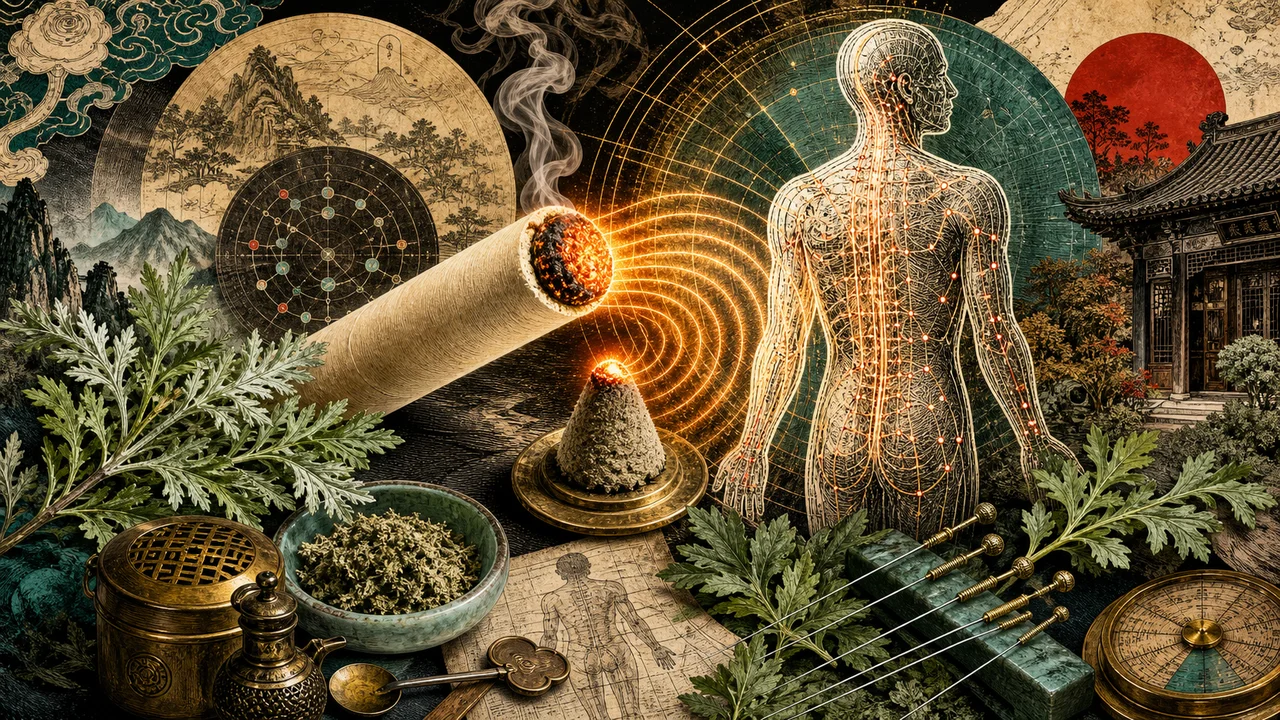
Moxa therapy, also called moxibustion, is a Traditional Chinese Medicine technique that uses heat produced by the controlled burning of moxa to warm acupuncture points and specific regions of the body. It may be applied directly or indirectly and requires careful control of temperature, distance and time.
In this article, you will understand what moxa is, how sticks, cones and warmed needles are used, how heat reaches the skin and tissues, and how Chinese Medicine interprets the technique. You will also learn about the mechanisms under investigation and the stages of a session.
Continue reading to understand the differences among moxa therapy methods, recognize the main safety precautions and see why individual assessment is indispensable before any application. You will then be able to understand the technique more clearly without reducing its practice to the simple use of a heat source.
What is moxa therapy?
Moxa therapy, also called moxibustion, is an external technique of Traditional Chinese Medicine that uses heat produced by burning moxa. The material is applied on the skin or held close to it to warm acupuncture points and specific regions of the body in a controlled manner.
Although it is often associated with acupuncture, moxa therapy does not necessarily depend on the use of needles. It can be applied as an independent technique, combined with inserted needles or used with different supports between the moxa and the skin. The choice depends on the purpose, the region being treated and the method adopted.
The central element of the technique is the thermal stimulus. Combustion produces gradual heat that reaches the body's surface and may affect tissues beneath the skin. The intensity of this stimulus varies according to the form of moxa, the amount used, its distance from the skin, the length of exposure and the application method.
What is the moxa used in the technique?
Moxa is the name given to the material prepared for moxa therapy. Traditionally, it is made from dried and processed mugwort leaves, especially Artemisia argyi. After the leaves are ground and sifted, their fibers form a soft mass known as moxa wool, which is used to make cones, sticks and other devices.
Mugwort became the technique's main material because its fibers hold their shape and have properties suited to combustion. Moxa can remain lit and burn slowly, producing relatively uniform heat and allowing the practitioner to control its proximity, movement and the time it remains over the selected point.
The plant contains volatile oils and different chemical compounds, but the presence of these substances does not mean that all their possible effects occur during moxa therapy. Research studies both the composition of mugwort and the products released by combustion, but heat remains the most evident and directly observable component of the technique.
What is the difference between direct and indirect moxa therapy?
In direct moxa therapy, a small portion of moxa, usually shaped like a cone, is placed directly on the skin and lit. Some techniques remove the cone before the heat causes injury, while historical methods allowed blisters or scars to form intentionally. These practices have very different intensities and risks.
In indirect moxa therapy, the moxa does not remain in direct contact with the skin. It can be held at a certain distance or placed over a barrier, such as a specific support or a traditional layer of another substance. This separation allows heat to be transferred to the point with greater control and a lower risk of burning.
The difference between the methods lies in more than the existence of contact. Distance, cone size, the presence of barriers, airflow and duration modify the temperature that reaches the skin. Results obtained with one method therefore cannot automatically be attributed to every other form of moxa therapy.
How are moxa sticks, cones and needles used?
A moxa stick is made from processed mugwort compressed into a shape resembling a small cylinder. After it is lit, the stick is held close to the skin and may remain over one point or be moved around a particular region. The practitioner continually controls the distance to produce warmth without causing pain or injury.
Cones are small portions of moxa wool shaped to remain on the skin or on a barrier. Their size, degree of compression and number determine part of the intensity applied. Because the temperature can increase quickly, the method requires constant observation and removal at the proper moment.
In the technique known as moxa on a needle, a portion of the material is attached to the end of an acupuncture needle that is already in place. Combustion warms the structure and the region around the point. In this case, moxa therapy and acupuncture are combined but continue to produce different stimuli: one thermal and the other mechanical.
How does moxa heat reach the skin and tissues?
The heat produced by moxa reaches the body through different forms of thermal transfer. When the material remains close to the skin, some of the energy is transmitted mainly by radiation and heated air. When there is contact or a barrier between the moxa and the skin, conduction also participates in the process.
Experimental studies show that temperature does not remain limited to the surface. Depending on intensity and time, warming can reach layers beneath the skin. Its depth and thermal distribution are not constant, however, because they change with distance, device design, ventilation and tissue characteristics.
An appropriate stimulus should produce a gradually increasing and tolerable sensation of heat. Intense pain, burning or uncomfortable warmth indicates that the application needs to be stopped or adjusted. The patient's perception is important but is not sufficient for people with reduced sensitivity, who may not recognize temperatures capable of causing burns.
How is moxa therapy explained by Chinese Medicine?
In Traditional Chinese Medicine theory, moxa therapy is used to warm points and meridians, support the circulation of Qi and Blood and address patterns associated with Cold. Fire and the warming nature of moxa are understood as resources capable of modifying processes characterized by contraction, slowness or difficulty in circulation.
The technique may also be used to strengthen particular functions when assessment identifies a deficiency pattern. This does not mean that moxa simply adds a measurable amount of energy to the body. The expression “strengthening Qi” belongs to the functional model of Chinese Medicine and describes a therapeutic purpose defined by this tradition.
Application sites are selected according to pattern differentiation, not only the name of a symptom. The practitioner considers the affected region, the nature of the condition, the presence of Cold or Heat and the person's general circumstances. Two patients with similar complaints may therefore receive different points and techniques.
Which mechanisms are investigated by modern research?
Modern research primarily investigates the thermal effects of moxa therapy. Warming may stimulate temperature-sensitive receptors in the skin and produce local responses in blood vessels and tissues. Experimental studies also examine how heat intensity changes these responses, but their findings do not establish a single mechanism applicable to every condition.
Another line of research examines the radiation emitted during combustion, including infrared wavelengths. Experiments have identified particular characteristics in moxa's radiation spectrum, but it has not yet been demonstrated that this emission has a clinical effect unique or superior to other forms of controlled warming.
Possible neurological, circulatory, immune and inflammatory responses are also studied, along with the activity of volatile compounds released by mugwort. Many of these hypotheses come from laboratory or animal studies. They help formulate explanations but do not prove the technique's clinical efficacy in humans on their own.
How is a moxa therapy session performed?
A session begins with an assessment to determine whether the use of heat is compatible with the pattern presented. The points, moxa method, patient's position and intended intensity are then selected. These factors are important because different techniques produce distinct thermal stimuli and cannot be applied in the same way.
During application, the practitioner observes the skin, the response to heat and the stability of the lit material. Distance, duration, amount of moxa and number of repetitions are adjusted according to the region and the person's sensitivity. The room must also be properly ventilated because combustion produces smoke and odor.
At the end, the material must be completely extinguished and the skin examined. Mild, temporary redness may occur after warming, but pain, blisters or injuries should not be regarded as necessary consequences of the technique. Modern moxa therapy seeks to produce a controlled thermal stimulus while avoiding burns and unnecessary exposure to smoke.
What are the precautions and limits of moxa therapy?
Moxa therapy can cause burns, allergic reactions, infections and discomfort related to smoke. Case reviews have also recorded events associated with improper application, excessive contact with the skin and lack of thermal control. The technique should therefore be performed by a trained practitioner using appropriate materials.
Greater care is needed for people with reduced sensitivity, circulatory changes, difficulty communicating or skin lesions. Fire should not be kept near flammable fabrics, hair or clothing, and application must take place in a ventilated room. Home use without training increases the risk of accidents and application under unsuitable conditions.
Moxa therapy has a growing body of research, but the quality of evidence varies considerably by condition and method. Reviews have identified inadequate descriptions of methods, points, duration and adverse events, making comparisons difficult. Its results should therefore be assessed by clinical problem, without generalization and without replacing necessary medical care.
Frequently Asked Questions
It is a Traditional Chinese Medicine technique that uses heat produced by burning moxa to warm points and regions of the body.
No. It can be applied on its own with sticks or cones, or combined with acupuncture needles.
In direct application, moxa is placed on the skin. In indirect application, it remains at a distance or is separated by a barrier.
Heat should increase gradually and remain tolerable. Intense pain, burning or discomfort requires adjustment or interruption.
Distance, temperature and time must be controlled, the skin observed, the room ventilated and the material completely extinguished at the end.
Deepen your understanding of moxa therapy
Understanding application methods, point selection and heat precautions is essential for studying moxa therapy responsibly.
Explore our e-books for clear, organized material on energetic traditions, personal awareness and practical study.
Explore the e-books
About the author
Prof. Tibério Z has more than 30 years of experience teaching spirituality, metaphysics, holistic therapies and consciousness development.