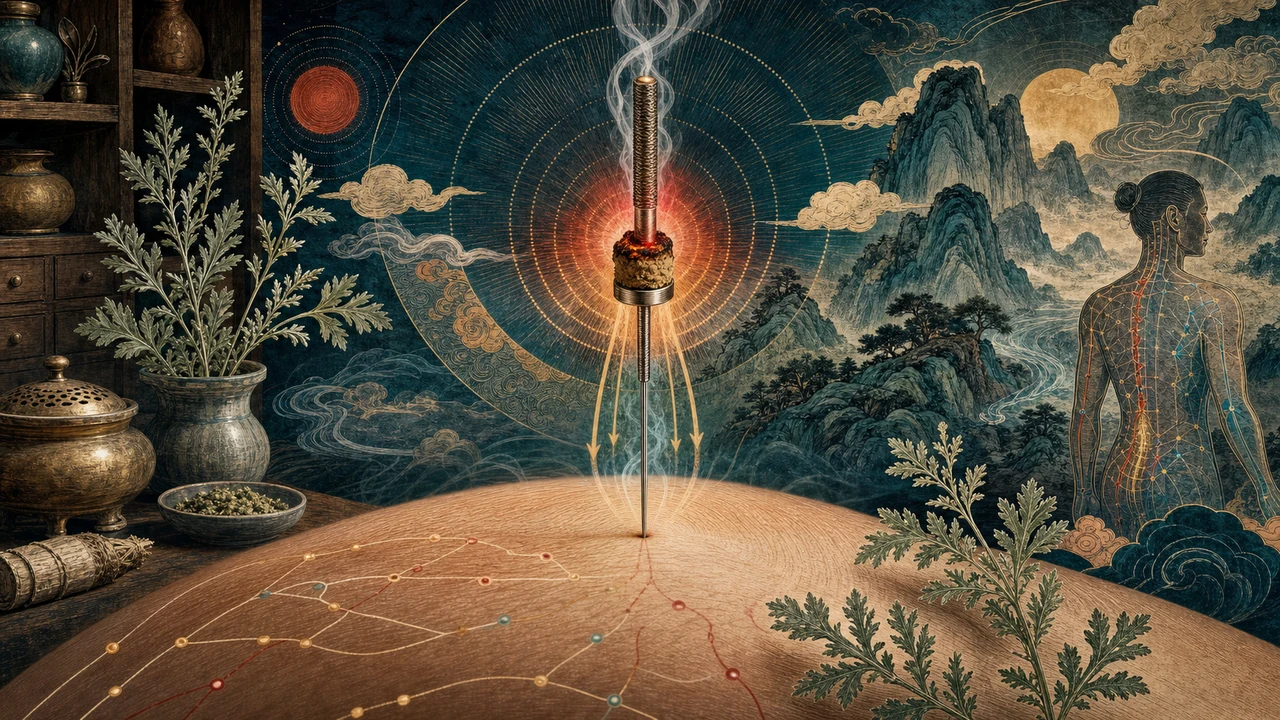
Needle-warming moxibustion is a technique that combines acupuncture and moxa therapy: the needle is inserted into the selected point, and a portion of moxa is attached to its handle to produce gradual, controlled warming around the region.
In this article, you will understand how points are chosen, how the needle and moxa are positioned, how heat reaches the body, which sensations may arise and which precautions reduce the risks connected with needling and combustion.
Continue reading to follow each stage of needle-warming moxibustion and understand why stability, distance, thermal control and professional training are indispensable for safe application.
What is needle-warming moxibustion?
Needle-warming moxibustion, also called a warming needle or warm-needle moxibustion, is a technique that combines acupuncture and moxa therapy. First, a needle is inserted into the selected point. A portion of moxa is then attached to the needle handle and lit to produce local warming.
Unlike moxa therapy performed only with sticks or cones, this method keeps a needle inserted during combustion. The person therefore receives two simultaneous stimuli: the mechanical stimulus caused by the needle and the thermal stimulus generated by the lit moxa on its external end.
The expression “warming needle” may give the impression that the entire needle is heated directly before insertion. In the traditional technique, however, the needle is inserted first and moxa is burned afterward on its handle. This procedure should not be confused with fire needling.
How are points chosen for application?
Point selection begins with an assessment similar to one performed during an acupuncture session. The practitioner considers the complaint, affected region, the person's general condition and the pattern recognized by Chinese Medicine. Needle-warming moxibustion is not automatically applied to every point used during the session.
Because the technique produces heat, the practitioner also assesses whether warming is compatible with the treatment objective. In traditional theory, it is usually associated with patterns characterized by Cold, reduced movement and difficulty in circulation. This interpretation belongs to the Chinese Medicine model and does not constitute a biomedical diagnosis.
Anatomical location also affects the choice. Certain regions require special care with needle depth and direction regardless of whether moxa is used. Sterile, disposable needles should be used because improper procedures may cause infections, tissue injuries and other complications.
How is the needle inserted before the moxa is applied?
After the skin is cleaned, the needle is inserted into the chosen point at a depth and direction compatible with the region. It must remain stable enough to support the moxa without tilting, shifting or unduly increasing pressure on the tissues during combustion.
The practitioner may initially manipulate the needle according to the acupuncture technique being used. The handle then remains exposed above the skin to receive the moxa. Positioning must leave enough space between the combustible material and the body to prevent the flame, ash or excessive heat from directly reaching the surface.
Needle insertion continues to require the same precautions as ordinary acupuncture. Minor bleeding, bruising, pain or dizziness may occur, while serious complications are rare when the procedure is performed correctly. Risk increases with deep needling, improper technique or lack of anatomical knowledge.
How is moxa placed on the needle handle?
Moxa wool may be shaped into a small sphere, cylinder or compacted portion around the handle. Another possibility is to use a small, prepared segment fitted onto the external part of the needle. The material must remain secure and centered before it is lit.
The amount used changes the duration and intensity of the stimulus. A larger portion contains more combustible material and may remain lit longer. Compaction, fiber quality, distance from the skin and air circulation also affect the temperature produced around the point.
The moxa should not be loose or excessively close to the body. The practitioner may place protection beneath the material to catch embers or ash that fall away. This barrier must be positioned without pressing the needle or changing its position inside the tissues.
How is combustion started and controlled?
Once the needle and moxa are stable, the upper part of the material is lit. Combustion advances gradually, producing heat, smoke and ash. The practitioner remains beside the person, observing needle stability, the behavior of the moxa and changes in skin temperature.
The amount of heat does not depend solely on the visible flame. The distance between the moxa and skin, portion size, needle thickness, burning time and air currents change the thermal stimulus. Experiments show that different arrangements produce distinct temperature profiles.
The material must not be left burning unattended. If the person feels burning, pain or excessive heat, the moxa must be removed or extinguished immediately. Thermal studies have identified potentially dangerous positions and periods, reinforcing the need for continuous control during application.
How does heat from the moxa reach the body?
It is often said that heat travels down the needle until it deeply reaches the point. Experimental studies, however, indicate that only a small part of the warming is conducted to deeper tissues through the metal shaft. The needle participates in transfer but does not function as a rod carrying all the heat into the body.
Much of the warmth perceived around the point comes from thermal radiation emitted by the moxa and from heated air between the material and the skin. The surface receives this stimulus and may transmit part of it to nearby layers according to temperature and exposure duration.
This explains why the distance between the moxa and skin is so important. Even when the needle remains relatively cool at depth, the surface may reach high temperatures. Safety should not be assessed solely by touching the needle handle, but by observing the entire thermal field formed around it.
Which sensations may occur during application?
Insertion may produce sensations similar to those of acupuncture, such as pressure, heaviness, tingling or distension around the point. Once the moxa is lit, a progressive sensation of warmth is added. Intensity varies according to the region, technique used and individual sensitivity.
The goal is to maintain tolerable warming without burning or intense pain. The sensation may gradually increase even when the moxa appears to be burning steadily. The person should therefore report any discomfort immediately, and the practitioner must observe the skin throughout the procedure.
The patient's reported perception should not be the only control method. People with reduced sensitivity may not recognize a temperature capable of causing injury. Safety studies show that the surface may become warmer than deeper tissues, increasing the risk of localized burns.
How is the session concluded?
When the planned amount of moxa has finished burning, the remaining material is carefully removed. Ash and embers must be placed in a heat-resistant container and completely extinguished. The needle should be removed only after there is no risk of lit fragments falling.
The practitioner then removes the needle, checks the insertion site and observes the skin that was exposed to heat. Mild, temporary redness may occur, but blisters, burns and persistent pain should not be treated as necessary outcomes of an ordinary application.
Duration is not the same in every session. It depends on the amount of moxa, number of points and observed thermal response. There is no universal time that can be safely repeated for every person because different materials and arrangements produce distinct temperatures.
How is this technique explained by Chinese Medicine?
In traditional theory, needle-warming moxibustion seeks to combine the regulating action of acupuncture with the warming effect of moxibustion. It is described as a technique capable of warming the channels, dispersing Cold and promoting the movement of Qi and Blood in the stimulated region.
This explanation does not mean that the procedure injects heat or energy directly into the meridians. Terms such as warming the channels and moving Qi belong to the functional model of Chinese Medicine. In modern research, the technique is studied as a combination of mechanical, thermal and sensory stimulation.
Needle-warming moxibustion appears mainly in research related to pain and musculoskeletal problems, especially osteoarthritis. Favorable results have been reported, but an assessment of fifteen systematic reviews rated the methodological quality of all of them as critically low, with evidence ranging from very low to moderate.
What are the risks and safety precautions?
The technique combines risks associated with needling and combustion. Pain, minor bleeding, bruising, burns, allergic reactions, infections and irritation caused by smoke may occur. Falling moxa or lit ash may also injure the skin, clothing or nearby materials.
The needle must remain stable and the moxa must be securely attached. The environment requires ventilation, fire protection and an appropriate container for extinguishing the material. Burning, excessive heat, breathing difficulty, dizziness or any unusual reaction requires immediate interruption and assessment of the patient.
Needle-warming moxibustion is not a technique intended for home use or use without specific training. It requires knowledge of acupuncture, anatomy, thermal control and fire management. It also must not replace necessary medical examinations, diagnoses or treatments, especially in the presence of persistent pain, intense inflammation or loss of function.
Frequently Asked Questions
It is a technique that combines acupuncture and moxa therapy. The needle is inserted first, and moxa is then placed on its handle and lit.
No. In needle-warming moxibustion, moxa burns on the handle after the needle is inserted. Fire needling is a different technique.
Most of the heat reaches the skin through thermal radiation and the heated air around the moxa. Only a small part travels through the needle's metal.
Sensations characteristic of acupuncture may occur along with gradual, tolerable warmth. Burning or intense pain requires immediate interruption.
The needle and moxa must remain stable, at a safe distance from the skin, with protection against ash and continuous monitoring by a qualified practitioner.
Deepen your understanding of needle-warming moxibustion
Needle-warming moxibustion requires mastery of needling, material stability, heat control and continuous monitoring throughout combustion.
Explore our e-books for clear, structured material on energy, balance and integrative practices.
Explore the e-books
About the author
Prof. Tibério Z has more than 30 years of experience teaching spirituality, metaphysics, holistic therapies and consciousness development.