
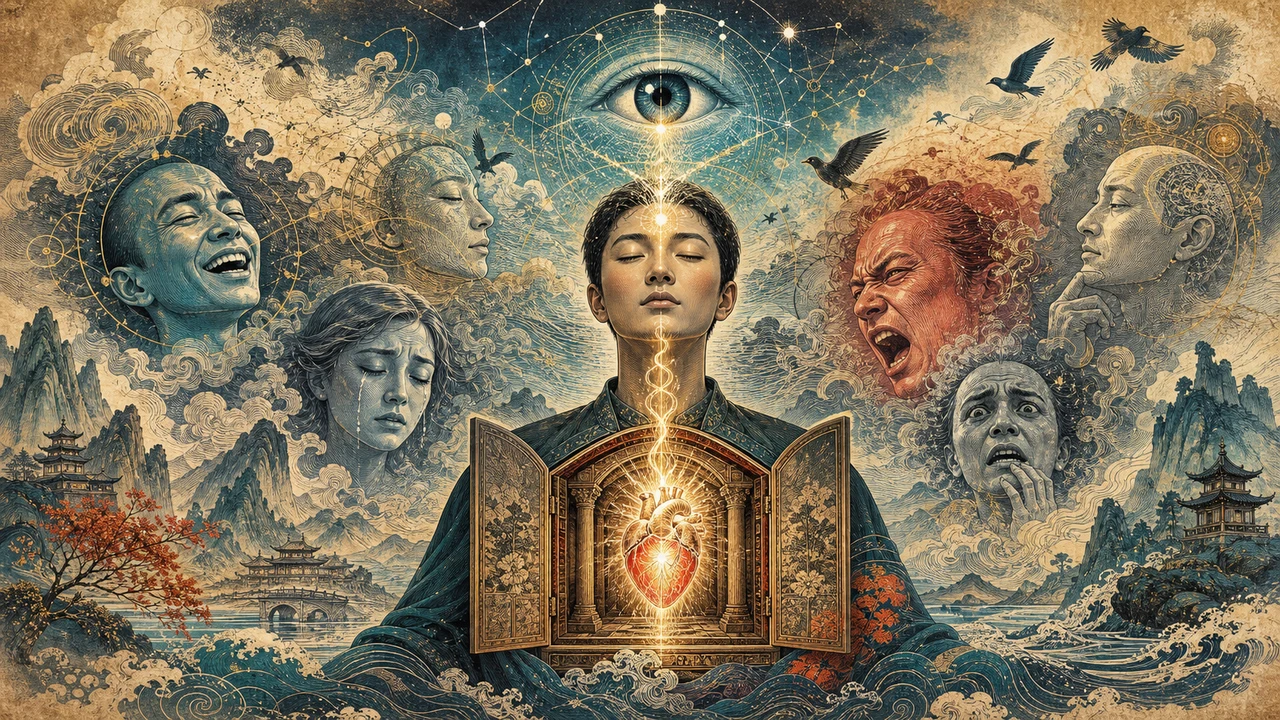
Shen is the concept in Chinese Medicine that brings together consciousness, thought, perception, emotions, and mental expression. Related to the Heart system, it represents the conscious presence manifested in the gaze, speech, attention, and the way a person responds to experiences.
In this article, you will understand why Shen can be translated as Mind or Spirit, how it relates to the Heart, memory, perception, and emotions, and which signs traditionally help observers assess its condition.
Continue reading to learn about this concept without reducing it to the rational mind, a religious soul, or an isolated anatomical structure.
What Shen means in Chinese Medicine
Shen is a concept used by Traditional Chinese Medicine to represent the conscious, mental, and expressive dimension of the human being. It is related to the ability to perceive, think, feel, communicate, and respond to experiences. Therefore, it contributes to the traditional understanding of the mind, emotions, and behavior.
The term does not describe only an intellectual function. Shen also indicates the conscious presence that can be perceived in the clarity of the gaze, the coherence of speech, attention, and the way a person relates to the environment. Its meaning encompasses both psychic activity and the vitality expressed by the individual.
Within the traditional model, Shen is not presented as an organ, a liquid, or an anatomical structure. It represents a set of manifestations recognized through consciousness and behavior. Its condition is observed through the way mental, emotional, and perceptual capacities appear in an integrated manner.
Why Shen can be translated as Mind or Spirit
Shen is commonly translated as Mind, Spirit, consciousness, or mental vitality. None of these words alone reproduces all the meanings of the Chinese term. The choice of translation depends on context because Shen may indicate a human faculty, a quality of consciousness, or a broader manifestation of life.
The translation as Mind highlights its relationship with thought, perception, and conscious activity. The word Spirit, in turn, seeks to preserve the broader dimension of the concept, which includes presence, vitality, and individual expression. In this medical context, Spirit does not need to mean a supernatural entity separate from the body.
Keeping the word Shen alongside its translation avoids restricting it to a single interpretation. Chinese terminology was built within a conception in which body, affectivity, and cognition remain related. Translating Shen only as rational mind would erase part of this integration among thought, emotion, and bodily expression.
Whether Shen corresponds to the Western concept of soul
Shen does not correspond exactly to the concept of soul found in certain Western religious and philosophical traditions. In Chinese Medicine, it is studied primarily through its manifestations in a living person, such as consciousness, attention, expression, thought, perception, and emotional response.
Ancient Chinese theory was not organized around the same rigid separation between body and mind that marked part of modern Western thought. Mental and emotional activities were understood within an embodied person whose psychic functions depended on their overall condition and internal relationships.
For this reason, Shen should not be presented as something that simply inhabits a body independently of it. It describes a dimension manifested through bodily life, conscious capacities, and interaction with the world. This understanding preserves the medical meaning of the term without imposing inappropriate religious equivalences.
Why Shen is related to the Heart
In the classical texts of Chinese Medicine, the Heart is described as the place that stores or houses Shen. This association means that the functions attributed to the Heart system include the organization of consciousness, mental activity, and emotional expression, in addition to its other traditional functions.
The Chinese term Xin can mean both heart and heart-mind. In ancient Chinese philosophy, this word designated a center related to both cognition and feelings. Thinking and feeling were not distributed between two completely separate domains, but were understood as activities belonging to the same human reality.
This relationship does not mean that Chinese Medicine is literally describing the heart muscle as equivalent to the brain. The traditional Heart is a functional system broader than the anatomical organ. Saying that it houses Shen expresses a theoretical organization of its own, not a claim of modern cardiology.
How Shen participates in consciousness and perception
Consciousness allows a person to recognize themselves, perceive the environment, and respond to what happens. In Chinese Medicine, these capacities are considered manifestations of Shen. It is present in the way experiences are received, understood, and integrated into an individual's conscious state.
Within this model, perception does not depend only on the isolated functioning of the sense organs. Seeing, hearing, or feeling also requires information to be recognized by consciousness. Shen represents this mental presence that allows stimuli to become perceived experiences endowed with meaning for the person.
When consciousness is clear, a person tends to show presence, orientation, and the ability to respond coherently. When it is confused, their perceptions and reactions may become disorganized. These observations belong to traditional clinical language and do not replace the neurological or psychiatric assessment performed by modern medicine.
How Shen relates to thought, attention, and memory
Shen participates in the ability to maintain attention, organize thoughts, and act consciously. It allows mental activity to have direction and coherence. A mind that follows a conversation, recognizes its environment, and can formulate responses demonstrates qualities traditionally related to an organized manifestation of Shen.
This does not mean that all cognitive functions are attributed exclusively to Shen. Chinese Medicine also uses other concepts to explain intention, reflection, memory, planning, and willpower. Shen occupies an integrating position, bringing these different activities together within a person's conscious experience.
Memory, for example, can be analyzed through different functional relationships, depending on the type of difficulty observed. However, the participation of Shen is necessary to consciously recall, recognize, and communicate information. It provides the conscious field in which the various mental faculties can manifest.
What the relationship is between Shen and emotions
Emotions are part of the manifestations of Shen because they are experiences recognized and lived through consciousness. Joy, anger, sadness, fear, worry, and other affective responses are not treated as elements foreign to the mind, but as movements that participate in how a person perceives and interprets their reality.
Ancient Chinese philosophy often used the heart-mind to bring thoughts and feelings together. This tradition influenced how Chinese Medicine understood emotional life. Emotion does not occur separately from the body because it can change posture, expression, respiration, speech, and behavior.
Shen does not correspond to a single emotion. It is the conscious dimension through which feelings are perceived, expressed, and integrated. Different emotions may appear without indicating a problem. The central question is how they participate in the experience and whether the person retains the ability to recognize and respond to them.
How intense emotions can affect Shen
In Chinese Medicine, emotions are considered natural parts of life. They receive greater attention when they become very intense, prolonged, repetitive, or difficult to process. Under these conditions, they can interfere with the clarity, rest, and stability attributed to Shen.
Classical texts related fear, worry, and excessive reflection to changes in Shen. This does not mean that feeling these emotions automatically causes disease. The theory considers intensity, duration, context, and capacity for recovery because a passing reaction differs from a state that continues to dominate conscious experience.
Just as emotions can affect Shen, an agitated or disorganized consciousness changes the way situations are interpreted. A person may react with greater sensitivity, difficulty concentrating, or emotional instability. The relationship is understood as reciprocal, not as a sequence with a single cause.
How the state of Shen can be observed
Shen is observed primarily through a person's overall manifestations. Clarity of the gaze, coherence of speech, attention, facial expression, orientation, and quality of contact are considered relevant information. These signs make it possible to assess how consciousness and mental vitality appear during an interaction.
A harmonious Shen is commonly associated with presence, coherent communication, and the ability to respond in a way compatible with the context. This does not require a person to be cheerful or calm all the time. They may feel sadness or fear and still maintain adequate consciousness, recognition, and expression.
Changes in speech, attention, behavior, contact, or the organization of thought may traditionally be described as disturbances of Shen. However, these signs may also be present in clinical conditions that require specialized assessment. The traditional concept should not be used to replace medical or psychological diagnoses.
How to understand Shen in the present-day context
Shen should be understood as a concept belonging to the theoretical system of Traditional Chinese Medicine. It provides a language for relating consciousness, thought, emotion, behavior, and bodily expression. Its usefulness lies in how it organizes these observations within the Chinese medical tradition.
The term has no direct equivalent in the brain, nervous system, psychological mind, personality, or religious soul. Possible approximations exist, but none fully reproduces the concept. Shen brings together dimensions that contemporary terminology commonly distributes among different fields of knowledge.
There is also no biomedical test capable of measuring Shen as an independent structure. Persistent changes in memory, consciousness, behavior, sleep, or emotional state need to be investigated by the appropriate professionals. The traditional explanation can complement the cultural understanding of care, but it does not replace necessary medical and psychological assessments.
Frequently Asked Questions
Shen is the concept connected to a person's consciousness, thought, perception, emotions, and mental expression.
Because the term brings together conscious activity, thought, presence, vitality, and expression. No single translation represents the entire concept.
The traditional Heart system includes the organization of consciousness, mental activity, and emotional expression.
Emotions that are very intense, prolonged, or repetitive can interfere with the clarity, rest, and stability of consciousness.
It is observed through clarity of the gaze, coherence of speech, attention, facial expression, orientation, and quality of contact.
Deepen your study of Shen in Chinese Medicine
Understanding Shen helps relate consciousness, thought, emotions, and expression within the integrated view of Chinese Medicine.
Explore our e-books for clear, organized material that connects this and other traditional foundations with the practice of Chinese Medicine.
Explore the e-books
About the author
Prof. Tibério Z has more than 30 years of experience teaching spirituality, metaphysics, holistic therapies and consciousness development.