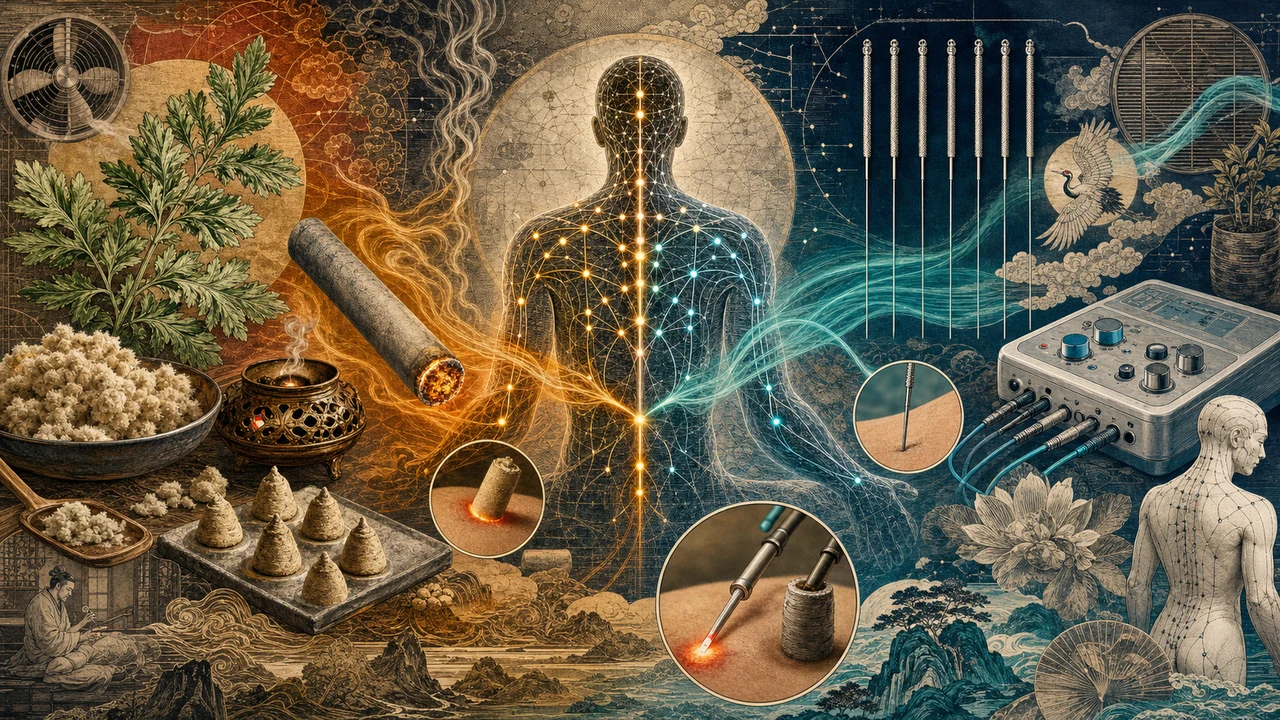
Moxa therapy and moxibustion generally name the same practice of warming with moxa, while acupuncture primarily uses needles to stimulate points on the body. The central difference therefore lies in the type of stimulus: thermal with moxa and mechanical with needling.
In this article, you will understand how the terms moxa therapy and moxibustion are used, what characterizes acupuncture, and which materials, sensations and precautions distinguish the techniques. You will also learn how they can be combined and which criteria guide their application.
Continue reading to compare these practices clearly and understand why, although they share foundations of Chinese Medicine and may use similar points, they are neither equivalent nor interchangeable.
What do the terms moxa therapy and moxibustion mean?
Moxa therapy and moxibustion are terms used for treatment performed with moxa, a material traditionally prepared from processed mugwort leaves. The technique produces a thermal stimulus over acupuncture points or regions of the body through the controlled burning of this material.
In everyday use, the two words are often treated as synonyms. Moxa therapy emphasizes the idea of treatment with moxa, while moxibustion is the technical term most often used in international documents and academic publications for the traditional practice of warming by burning moxa.
There are therefore generally not two different techniques called moxa therapy and moxibustion. The distinction lies mainly in the terminology chosen. When someone says they practice moxa therapy, they are normally referring to the same practice that international literature calls moxibustion.
Is there any practical difference between moxa therapy and moxibustion?
In the traditional and strict sense, moxibustion involves burning moxa to produce heat. The material can be used in sticks, cones, small grains or on needles. Application may take place directly on the skin, over a barrier or at a certain distance from the body.
The term moxa therapy may be used more broadly to bring together different forms of treatment inspired by moxa. Some modern approaches use electrical devices, infrared light, lasers or other heat sources that seek to reproduce part of the thermal stimulus without burning mugwort.
However, there is no universal convention that requires this distinction. Many practitioners continue to use moxa therapy and moxibustion as equivalent names. The most important thing is therefore to verify which material, heat source and method of application are being used rather than interpreting the technique by its name alone.
What is acupuncture?
Acupuncture is a technique in which thin needles are inserted through the skin to stimulate specific points on the body. The needles may remain still, be manipulated by hand or receive small electrical currents, a method known as electroacupuncture.
In Traditional Chinese Medicine theory, points are selected according to the channels, organ functions and pattern identified during assessment. The technique seeks to modify the movement of Qi and Blood, regulate functions and restore relationships considered altered within this traditional system.
Modern research investigates the effects of acupuncture on the nervous system, tissues near the insertion site and nonspecific factors related to the therapeutic context. Its mechanisms are not yet completely understood, and its results vary according to the condition treated and the quality of the studies.
What is the main difference between moxibustion and acupuncture?
The main difference lies in the type of stimulus. Acupuncture predominantly uses needle insertion and manipulation, producing mechanical stimuli at the points. Moxibustion primarily uses heat generated by burning moxa, creating a thermal stimulus on the body's surface.
In acupuncture, the stimulus begins when the needle penetrates the skin and can be modified through rotation, lifting or deeper insertion. Indirect moxibustion does not necessarily involve piercing the skin. Heat is transferred through the proximity of a stick or the burning of a cone placed on a barrier.
The two techniques can stimulate the same points, but they do not produce exactly the same experience or bodily response. Research distinguishes mechanical, thermal and nociceptive stimuli, indicating that the method used influences the receptors activated and the local responses produced.
Which materials and instruments are used in each technique?
In traditional moxibustion, the main material is moxa wool made from mugwort. It may be shaped into cones, compressed into sticks or attached to the end of a needle. Supports, boxes, plant barriers and devices designed to control distance and heat may also be used.
Acupuncture uses thin needles, usually made of metal, that are sterile and disposable. Their length and thickness are selected according to the point, bodily region, intended depth and the patient's characteristics. Electroacupuncture adds wires and a device that sends a controlled current between the needles.
Thus, acupuncture primarily depends on needles, while moxibustion depends on a heat source, traditionally lit moxa. A person can receive moxa therapy without any needling, just as they can receive acupuncture without moxa. The presence of one technique does not necessarily require the use of the other.
Do moxibustion and acupuncture use the same points?
Both techniques may be applied to points belonging to the same traditional channel system. UNESCO presents acupuncture and moxibustion as related practices that stimulate bodily regions according to shared foundations of Chinese Medicine. This does not mean, however, that every point is treated in the same way.
Selection also depends on the nature of the desired stimulus. Moxa is traditionally associated with warming, dispersing Cold and strengthening deficiency patterns. A needle may be used in a wider range of tonifying, dispersing, moving and regulating strategies according to the way it is manipulated.
Certain regions may be unsuitable for the direct application of heat, while others require caution in needling because of their anatomy. It is therefore not enough to locate a point and freely choose between a needle and moxa. The technique must consider its purpose, depth, sensitivity, safety and the patient's characteristics.
How can acupuncture and moxibustion be combined?
One of the best-known forms of combination is moxa on a needle, also called warming needle therapy. First, the needle is inserted into the point. A small portion of moxa is then attached to its end and lit, producing heat around the region being treated.
In this procedure, the patient receives two types of stimulus at the same time. The needle produces mechanical stimulation through insertion, while the moxa adds heat. The combined technique should not be regarded simply as warmer acupuncture because it brings together methods with their own characteristics and precautions.
It is also possible to insert needles at some points and use moxa sticks or cones at others. The combination depends on assessment and is not a mandatory rule. In certain sessions, only one of the techniques may be considered suitable for the pattern and the conditions presented by the person.
What sensations may occur during each application?
During acupuncture, a brief sensation may occur as the needle is inserted, followed by heaviness, pressure, tingling, distension or a radiating sensation. The experience varies with the point, depth, manipulation and individual sensitivity. Intense or persistent pain should not be considered necessary for the technique to work.
In moxibustion, the predominant sensation should be gradual, tolerable heat. The patient may notice localized warmth or a sensation that spreads across the region. Stinging, pain or excessive heat indicates that the distance, amount of moxa or application time must be adjusted.
The two experiences differ because one mainly involves needling and the other warming. People who fear needles may tolerate indirect moxibustion better, but this does not make moxa suitable for everyone. Changes in sensitivity may prevent a patient from recognizing a dangerous temperature.
What are the risks and precautions of each technique?
The most common risks of acupuncture include minor bleeding, pain at the needle site, bruising and temporary reactions. Serious complications are rare when the technique is performed correctly, but infections, injuries and pneumothorax can occur when hygiene, training or anatomical knowledge is inadequate.
In moxibustion, the main risks are related to fire, heat and smoke. Burns, blisters, allergic reactions, respiratory irritation and fires may occur. Application requires continuous monitoring, proper ventilation and special care for people with reduced sensitivity or difficulty communicating.
Moxa therapy, moxibustion and acupuncture belong to the same traditional field but are not interchangeable techniques. The choice must consider the pattern identified, the condition being treated, the risks and the patient's preferences. None of them should delay necessary examinations, diagnoses or medical treatments.
Frequently Asked Questions
Generally, yes. Both terms usually indicate the practice that uses moxa to produce heat over points or regions of the body.
Moxibustion primarily uses a thermal stimulus, while acupuncture uses the insertion and manipulation of needles.
Moxibustion uses moxa wool in cones, sticks or other forms. Acupuncture uses thin, sterile and disposable needles.
Yes. Moxa may be applied to an already inserted needle, or it may be used on different points during the same session.
Acupuncture requires hygiene and anatomical knowledge. Moxibustion requires control of fire, heat and smoke, as well as attention to the person's sensitivity.
Deepen your understanding of moxa therapy
Distinguishing moxa therapy, moxibustion and acupuncture helps us understand the materials, stimuli, combinations and precautions involved in each form of application.
Explore our e-books for clear, organized material on energetic traditions, personal awareness and practical study.
Explore the e-books
About the author
Prof. Tibério Z has more than 30 years of experience teaching spirituality, metaphysics, holistic therapies and consciousness development.