Traditional Chinese Medicine is a medical system that understands health as the result of a dynamic balance among bodily functions, mind, emotions, habits and environment. Instead of looking only at isolated symptoms, it brings different signs together to identify patterns, follow changes and guide care in an individualized way.
In this article, you will understand how this system developed, why it goes beyond acupuncture, how it interprets health and illness, and the roles of habits, environment, prevention and individual assessment within its approach.
Continue reading to learn the logic of Chinese Medicine and understand how its concepts organize an integrated, dynamic and responsible approach to healthcare.
What defines Traditional Chinese Medicine?
Traditional Chinese Medicine is a medical system formed by knowledge, assessment methods and healthcare practices developed in China over many centuries. It did not arise from a single discovery, but from a historical process of observing, recording and comparing experiences and transmitting knowledge among different generations.
This system was built from its own way of interpreting human function. Instead of using anatomical structures alone to explain the body, Chinese Medicine also organizes its observations through functional relationships, movements, transformations and correspondences identified among different parts of the body.
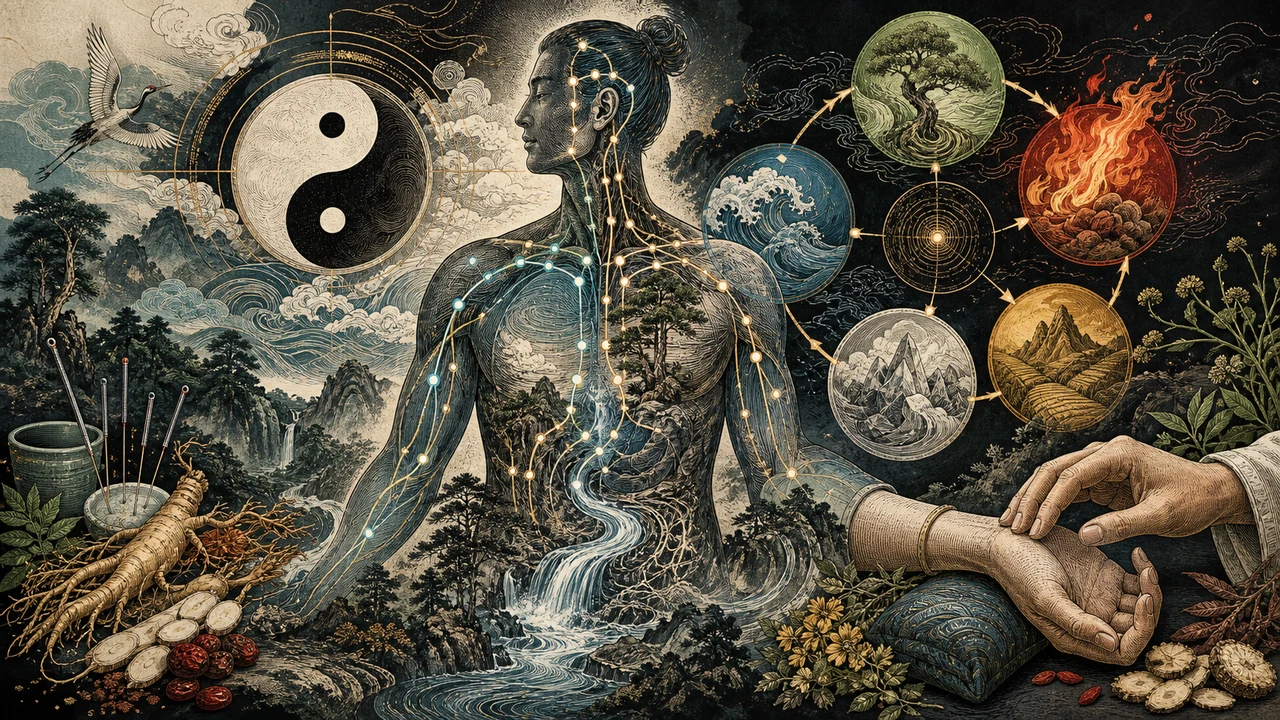
The term Traditional Chinese Medicine encompasses a set of resources rather than an isolated technique. Acupuncture, Chinese herbal medicine, body exercises, breathing practices and dietary guidance belong to this field, although each resource has its own characteristics, indications and forms of application.
Why is it considered a medical system?
Chinese Medicine is considered a system because it presents an organized structure for observing health, interpreting signs, differentiating patterns and selecting forms of care. Its concepts are related to one another and form their own logic, which is used to understand how the body's different functions influence each other.
This structure is not limited to the moment of treatment. It also provides criteria for following changes, assessing the development of a condition and modifying the approach as new manifestations appear. Observation is continuous because a person's state can change during illness or recovery.
For this reason, it is not correct to reduce Chinese Medicine to the use of needles. Acupuncture is one of its practices, but the system includes its own ways of investigating, interpreting clinical findings and organizing care. The choice of each resource depends on the practitioner's assessment and the needs that have been identified.
How does Chinese Medicine observe the human being?
Traditional Chinese Medicine observes the human being as a whole formed by interdependent processes. Physical functions, mental activity, emotions, habits and environmental conditions are considered parts of the same reality. A localized change may therefore be related to changes occurring in other areas of the body.
During an assessment, different kinds of information can be brought together to form a broad view of the person. Sleep, appetite, digestion, vitality, thermal sensations, emotional state, routine, history and characteristics of the symptoms are analyzed together rather than treated as completely separate information.
This integrated approach does not mean abandoning the observation of specific signs. It means interpreting each manifestation in the context in which it appears. The relationship between the body and its environment also has an important place, because external changes and living conditions can affect a person's ability to adapt.
What does it mean to be healthy in this approach?
In Chinese Medicine, being healthy does not simply mean having no diagnosed disease. Health also involves the coordinated function of the body, the preservation of vitality, the regularity of bodily functions and the ability to respond appropriately to the demands of everyday life.
A person may not have a defined disease and still notice persistent changes in sleep, digestion, energy or emotional state. Within this approach, these manifestations deserve attention because they may indicate that the body's functional organization is beginning to lose stability.
Health is recognized by the way a person maintains their functions and recovers their organization after periods of exertion, climatic changes or emotional shifts. The aim is not to reach an unchanging state, but to preserve the conditions that allow the body to adjust without remaining disorganized.
Why is health understood as a dynamic state?
Health is considered dynamic because the body does not remain the same over time. Age, seasons, time of day, work intensity, food and emotional experiences continually change its needs. Healthy functioning must accompany these changes without losing its capacity for regulation.
Temporary variations do not always represent illness. Tiredness after intense effort, a change in appetite during a period of worry or a greater need for rest at a certain time may be passing responses. Assessment considers the intensity, duration and repetition of these changes before interpreting them as a persistent pattern.
Health, therefore, is not a rigid condition that must always remain the same. It depends on the ability to adjust functions, distribute resources and recover stability after different demands. This idea explains why the needs of the same person may change throughout life.
How do habits and the environment participate in health?
Chinese Medicine considers health to be influenced by the relationship between individual characteristics and living conditions. Food, sleep, physical activity, work, rest, emotions and environment may support the maintenance of functions or require greater effort from the body to adapt.
These factors are not analyzed in isolation. Sleeping too little may produce different consequences according to diet, age, workload and the person's general state. Assessment seeks to understand how the various elements accumulate, compensate for one another or amplify their effects over time.
The environment also participates in this relationship. Temperature, humidity, dryness and seasonal changes can influence people in different ways. The response depends on constitution, previous conditions and length of exposure, which is why the same situation does not always produce the same manifestations in everyone.
How does Chinese Medicine interpret illness?
Illness is interpreted as a process in which certain functions stop relating to one another properly. Instead of looking only at the most evident symptom, assessment seeks to identify the set of changes that arose, how they developed and what relationships may exist among their different manifestations.
Symptoms act as signs that need to be related. Pain, tiredness, digestive changes, sleep disturbances and emotional reactions do not automatically form a single condition. The combination, intensity and development of these manifestations help identify the pattern presented by the person.
A pattern may also change over time. Manifestations that predominated at the beginning may weaken while others become more evident. Interpretation should therefore not remain fixed: the condition must be reassessed as the body responds and new information appears.
Why is the assessment individualized?
Assessment is individualized because people with similar complaints may present different sets of signs. Two people with the same pain, for example, may have different histories, aggravating factors, associated sensations and bodily responses. These differences influence interpretation and the organization of care.
Chinese Medicine uses pattern differentiation to bring manifestations together within a coherent structure. The focus does not remain solely on the name of the disease, but on the particular way it is presenting in that person. This characteristic is recognized as one of the central elements of its clinical practice.
Individualization also requires follow-up. An appropriate approach at one point may need adjustment when the pattern changes. This does not mean that any treatment can be freely selected, but that decisions must remain connected to the signs observed, the development of the condition and the patient's circumstances.
What is the role of prevention in Chinese Medicine?
Prevention seeks to preserve the ability to adapt before changes become more intense or persistent. This involves recognizing early changes, understanding which habits are placing excessive demands on the body and correcting factors that may allow an imbalance to continue.
In this context, appropriate food, rest, physical activity, an organized routine and care for the emotions are part of maintaining health. This guidance does not follow a single rule for everyone, because it must consider age, constitution, stage of life, work and individual needs.
Prevention as proposed by Chinese Medicine does not eliminate the need for vaccination, examinations, medical follow-up or care when important symptoms appear. Responsible use should be part of safe, coordinated care based on the person's real needs, without delaying necessary diagnoses or treatments.
How should Chinese Medicine be understood today?
Today, Traditional Chinese Medicine is used in different countries and may appear as a traditional, complementary or integrated practice within other services. The World Health Organization recommends that traditional medicines be incorporated into health systems with evidence, regulation, safety and respect for their cultures of origin.
It is also important to avoid broad claims about efficacy. Chinese Medicine includes very different practices, and each one needs to be assessed according to the condition treated, the quality of the research and potential risks. Some approaches show promising results for specific situations, while others still have insufficient or inconsistent evidence.
Responsible use requires qualified practitioners, appropriate materials and products subject to quality control. Adulterated substances, incorrectly identified plants and poorly applied techniques can cause complications. Complementary treatments should therefore be disclosed to the health professionals caring for the patient and should not replace urgent medical care.
Frequently Asked Questions
It is a medical system formed by knowledge, assessment methods and healthcare practices developed in China over many centuries.
No. It also includes Chinese herbal medicine, body exercises, breathing practices, dietary guidance and its own form of assessment.
It means keeping the body's functions coordinated, retaining the ability to adapt and recovering stability after the demands of everyday life.
Because people with similar complaints may have different histories, signs and aggravating factors, which changes both interpretation and care.
Prevention seeks to recognize early changes and adjust habits and living conditions before those changes become more intense or persistent.
Deepen your understanding of Chinese Medicine
Understanding the integrated approach of Traditional Chinese Medicine is the first step toward studying its foundations and applying its concepts with greater clarity and responsibility.
Explore our e-books for clear, organized material that connects energetic foundations with personal awareness and daily practice.
Explore the e-books
About the author
Prof. Tibério Z has more than 30 years of experience teaching spirituality, metaphysics, holistic therapies and consciousness development.