
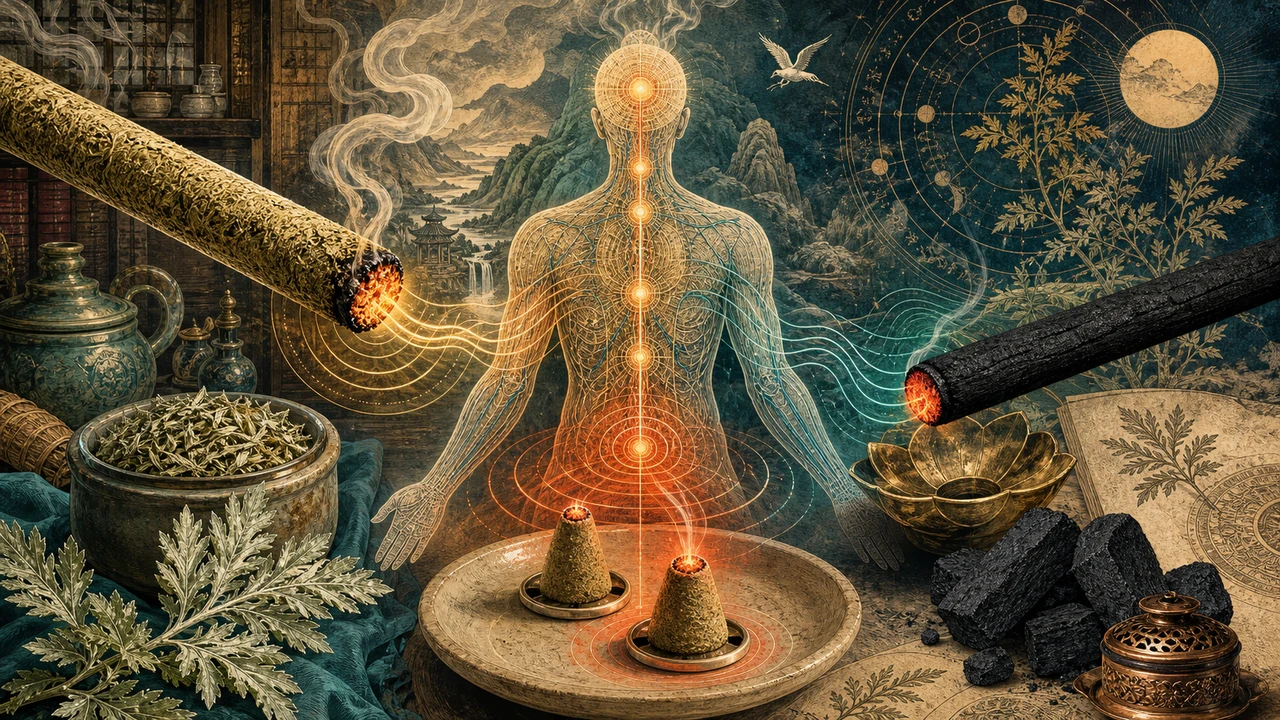
A moxa stick produces heat that can be continuously controlled through distance and movement; a moxa cone concentrates warmth in a small area; and charcoal moxa primarily changes the composition of combustion, reducing smoke and odor without necessarily producing less heat. Stick and cone are forms, while charcoal distinguishes the material used.
In this article, you will understand how each type is prepared and applied, how size, compaction and distance change the thermal stimulus, how cones may be used directly or indirectly, and which differences appear in smoke, odor and safety precautions.
Continue reading to clearly compare sticks, cones and carbonized products and understand why the choice must consider the method, treated area, ventilation and professional expertise.
What is the difference among these three types of moxa?
Moxa sticks and moxa cones are classified primarily by the form in which mugwort fiber is prepared. A stick forms a long cylinder, while a cone is a small molded portion designed to produce concentrated heat. Both traditionally use moxa wool as their raw material.
Charcoal moxa does not necessarily represent a third form. It is distinguished mainly by the carbonized material used in combustion and is usually sold in stick form. It is therefore possible to compare sticks and cones as forms, while the distinction between traditional and charcoal moxa concerns product composition.
Each modality produces a different form of warming. A stick allows continuous control of distance, a cone concentrates heat in a small area and charcoal moxa reduces some visible smoke. These differences change the application, duration, perceived intensity and necessary precautions.
How is a moxa stick prepared?
A traditional stick is made with moxa wool obtained by drying, grinding and sifting mugwort leaves. The fibers are gathered, compacted and wrapped in paper, forming a cylinder similar to a cigar. This structure makes it possible to hold the material and bring it close to the treated region.
Mugwort is suited to this form because its fibers remain grouped, retain their shape and sustain slow combustion. Once lit, the stick continues to burn without requiring a permanent flame. Its tip produces heat, thermal radiation, ash, odor and smoke during application.
The degree of compaction influences air intake and combustion behavior. Diameter, density, moisture and fiber quality may change burning time and the amount of heat produced. Therefore, sticks that appear similar do not always provide exactly the same thermal stimulus.
How is a moxa stick used?
Once lit, the stick is held near the skin without touching it. The practitioner may keep it relatively still over a point or move it around a region. Bringing the stick closer intensifies heat, while moving it away quickly reduces the thermal sensation perceived by the person.
Application may use circular, alternating or lengthwise movements according to the extent of the area to be warmed. Slow movement concentrates heat, while broader movements distribute the stimulus. Temperature is also influenced by the stick's size, the environment and air currents.
During combustion, ash accumulates at the tip and may fall away. It must be removed safely to prevent hot fragments from falling on the skin, clothing or treatment table. The stick continues burning after it is moved away and must be completely extinguished at the end of the session.
How is a moxa cone prepared and used?
A cone is formed with a small portion of moxa wool compressed between the fingers or molded with an instrument. It has a wider base and a narrow upper tip where combustion begins. Its size may range from small, delicate units to larger cones used in indirect applications.
The amount of fiber and degree of compaction change the cone's behavior. Larger units contain more combustible material and generally remain lit longer. Density also affects air intake, burning speed and the way heat advances toward the base.
Unlike a stick, which may be moved during application, a cone remains supported in one place. Its stimulus therefore tends to be more concentrated. The practitioner controls intensity by choosing the size, support, burning time and moment to remove or extinguish the moxa.
How can a cone be applied directly or indirectly?
In direct application, the cone is placed on the skin and lit. It may be removed before causing injury or remain until it produces an intentional burn in scarring techniques. The absence of a barrier concentrates heat and requires strict control to avoid accidental burns.
In indirect application, the cone is separated from the skin by a support or intermediate substance such as ginger, garlic or salt. This barrier changes heat transfer and allows warmth to reach the surface gradually. The material's thickness, moisture and composition influence the temperature reached.
There are also cones mounted on their own bases, adhesive supports and acupuncture needles. In these methods, heat is transmitted along different paths, including heated air, radiation and conduction. The mere presence of a base does not eliminate risk, because heat may pass through it during prolonged exposure.
What is charcoal moxa?
Charcoal moxa, often called smokeless moxa, is produced with carbonized mugwort material or formulations using charcoal and plant-derived components. It is usually black and rigid and is found mainly as a stick for indirect application.
Carbonization transforms part of the plant matter before use. As a result, combustion behaves differently from that of traditional wool wrapped in paper. The main practical purpose is to reduce the visible smoke and strong odor that may make use difficult in clinics and enclosed spaces.
The term “smokeless” should be understood as a reduction, not a complete absence of emissions. Any material subjected to combustion may release gases and particles. The amount depends on composition, ventilation, use time and the specific characteristics of the commercial product.
Does charcoal moxa produce less heat?
Charcoal moxa should not be assumed to be weaker merely because it produces less visible smoke. Studies show that carbonized products have their own combustion and thermal-radiation characteristics. Depending on how they are made, they may generate intense warming and require a different distance from that used with a traditional stick.
Research comparing traditional moxibustion with new smokeless forms has found differences in radiation spectra, although the theoretical maximum combustion temperatures may be similar. This indicates that the two materials are not thermally identical, even when they have similar forms and dimensions.
Charcoal may also take longer to light and retain a hot tip for a considerable time. Perceived intensity depends on distance, time and airflow. Replacing a traditional stick with a carbonized one therefore requires adjusting the technique rather than merely repeating the same application.
How do the three types differ in smoke and odor?
A traditional stick produces a noticeable amount of smoke and a characteristic aroma because it uses plant fibers subjected directly to combustion. Emissions include gases, volatile compounds and inhalable particles. Under normal, ventilated conditions, exposure is lower, but it increases when several sticks are used in enclosed spaces.
A traditional cone also produces smoke, but the total amount depends on its size and the number of units burned. Small cones use less material per application, while techniques employing many units may generate cumulative exposure. Barriers such as ginger or garlic also add their own odors to the environment.
Charcoal moxa considerably reduces visible smoke and may be more suitable when odor is a limitation. However, it does not remove the need for ventilation or allow practitioners to ignore people with asthma, allergies or respiratory sensitivity. Frequent and concentrated exposure to moxa smoke still requires preventive care.
How should you choose among a stick, cone and charcoal moxa?
A traditional stick offers continuous control of distance and can warm both isolated points and larger regions. A cone concentrates the stimulus and allows direct applications or use over barriers. Charcoal moxa reduces smoke and odor but has its own thermal characteristics that the practitioner must understand.
The choice should consider the size of the area, desired intensity, skin sensitivity, ventilation and the practitioner's experience. People with reduced thermal sensitivity require special attention because they may not notice that the temperature has exceeded a safe limit.
No form is automatically superior to the others. Sticks, cones and carbonized products produce different stimuli and should be used according to the method the practitioner has mastered. Regardless of the choice, application requires constant vigilance, fire control, protection against ash and immediate interruption in the event of burning or pain.
Frequently Asked Questions
Stick and cone refer to forms of moxa. The stick allows control of distance and movement, while the cone concentrates heat. Charcoal moxa differs mainly because of its carbonized material.
The lit stick is held near the skin without touching it. The practitioner controls heat through distance and may move it to concentrate or distribute the stimulus.
Yes. In direct application, the cone rests on the skin. In indirect application, there is a barrier or support between the cone and the body. Both forms require strict heat control.
It reduces visible smoke and odor but does not completely eliminate combustion gases and particles. Therefore, the environment still needs adequate ventilation.
Not necessarily. Carbonized products have their own thermal characteristics and may produce intense warming. Distance and time must be adjusted to the material used.
Deepen your exploration of the different types of moxa
Understanding form, composition, combustion, thermal intensity and smoke production helps in choosing the appropriate material for each application method.
Explore our e-books for clear, structured material on energy, balance and integrative practices.
Explore the e-books
About the author
Prof. Tibério Z has more than 30 years of experience teaching spirituality, metaphysics, holistic therapies and consciousness development.